Vanadium Batteries Are Super Cool, but Ungodly Expensive

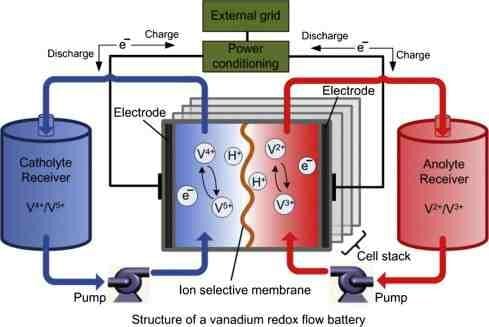
Vanadium redox flow batteries are one of those technologies that make engineers light up.
They are efficient and they last forever. Unfortunately, they're ungodly expensive.
Why Vanadium Batteries Are Genuinely Awesome
Let’s get the praise out of the way — because it’s deserved.
Vanadium flow batteries:
- Can cycle tens of thousands of times with almost no degradation
- Decouple power and energy (bigger tanks = more storage)
- Don’t catch fire
- Are extremely stable
- Are perfect for long-duration storage (4–12+ hours)
From a pure engineering perspective, they’re near perfect. Great hype piece here on Vanadium.
They’re one of the few grid-scale storage technologies that actually behaves like infrastructure instead of a consumable.
So why aren’t they everywhere?
The Part Everyone Tiptoes Around: Cost
The uncomfortable truth is simple:
Vanadium batteries are dominated by material economics.
And vanadium is not cheap.
At typical system scales, you’re paying for:
- Massive quantities of vanadium electrolyte
- Large tanks
- Pumps
- Heat exchangers
- Complex balance-of-plant
- Power electronics
- Installation and civil work
But vanadium itself is the real killer.
Vanadium Is a Commodity
Vanadium pricing is volatile, cyclical, and tied to steel markets. It's difficult to engineer around as opposed to other cost drivers (etc...logistics, manufacturing, labor). It's about 10x less earth abundant than lithium.
Which means:
- You don’t control your core input cost
- Every MWh added means more metal
- No learning curve magically makes the vanadium disappear
Unlike semiconductors or manufacturing-heavy systems, there’s no Moore’s Law hiding here.
If you want more energy storage, you need more vanadium.
Closing Thought
Vanadium batteries are an excellent case study in terms of what is near ideal for grid-scale storage...with the exception of cost. Price isn't everything, but in terms of rapid adoption necessary for a necessary energy transition. Vanadium batteries don't have the payback period that you need despite its performance. It's also difficult to engineer its costs to be lower through economies of scale because the material cost is so high. Thus, it was an excellent case study of what grid-scale storage could be, but as I projected the future, I didn't think it had the economic momentum from an established cost curve that Li-ion has.
Thus, I don't anticipate Vanadium to progress in adoption beyond niche applications.