The Pitch System
Pitching isn't just about a short speech and some slides. Learn the system to master influence and win high-stakes deals.

When I started pitching my first company, it was pretty sad. I was only 20 and I realized that making pretty slides and talking about them intelligently wasn't enough. It's a rude awakening that at the most critical stage of a startup, pitching it to investors, I had very little to prepare me.
I learned marketing and even studied sales, but nothing ever seemed to match. I studied influence, but even theories of influence are chaotic. I needed a robust system, that I could use in real-time backed, by first-principles.
Thus, I developed the "Pitch System", which takes all of my experience and studies to solve this one problem into a useable framework for not just understanding pitching, but pretty much any system of influence independent of form.
Structure
The structure is meant to be abstract so it can be adapted well to any situation. Some pitches are long. Some are short. The point is instead of "Here's 10 tips to improve your pitch", you can take this framework and tailor it to your specific situation for whatever it is you are pitching: your company, your product, yourself.
Really anything.
The structure is grounded by theory and also breadth. It's not about cheap tricks, it's about having the main process, structures, and theory that actually work in real life.
Stages
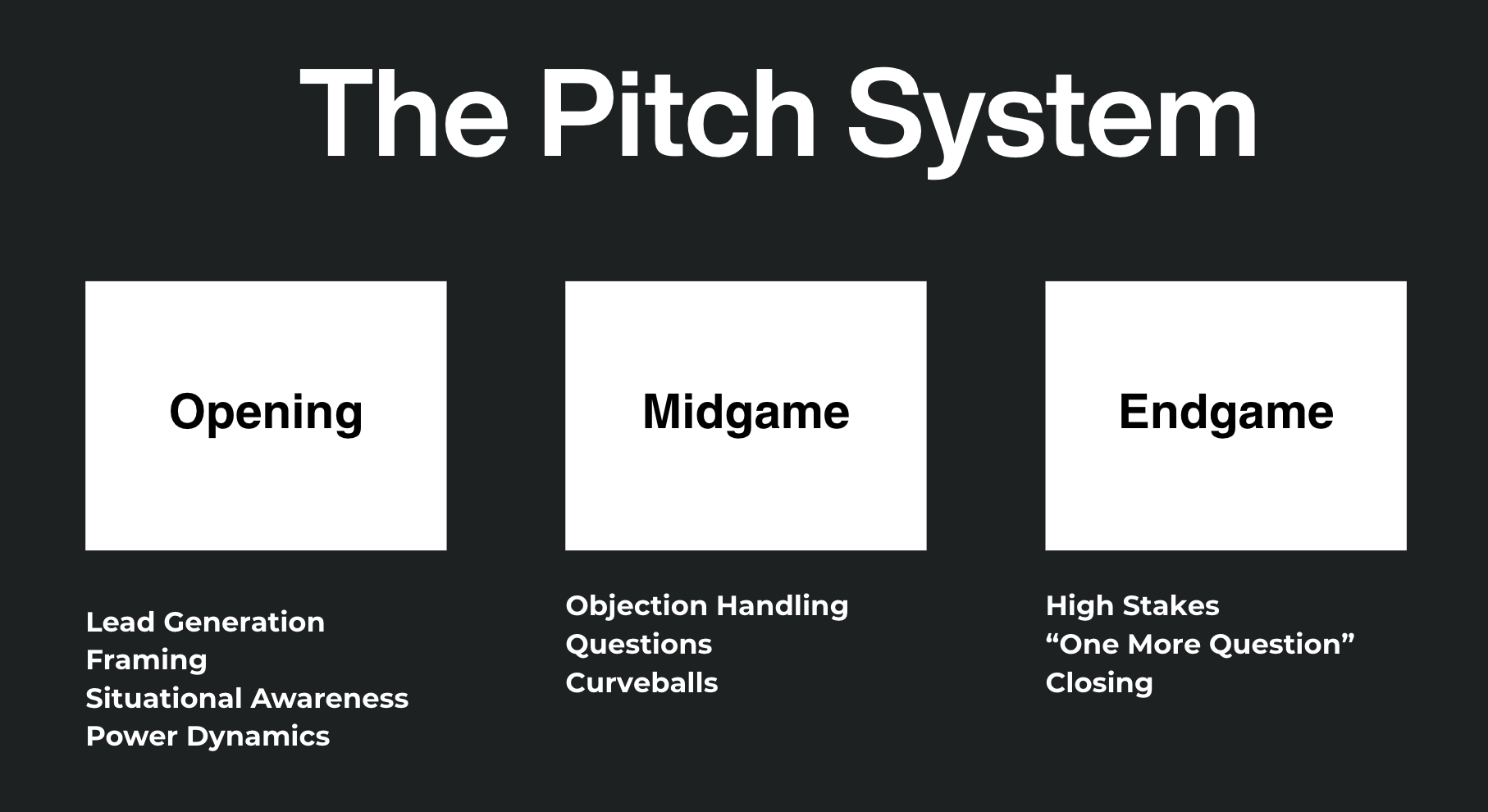
The stages of the pitch system aren't typical terms used in academia. I have a philosophy that strategy games are great analogies for life. In this case, I used frameworks from Go as the primary structure: Opening, Midgame, Endgame. The pitch is often seen as just the moment you say something quickly or even just a 20 minute presentation. You give your pitch. Then Yay or Nay?

But it can be much more than that. Before you even say anything, the banter during introductions, your setting, the power dynamics of the situation, and anything else before can lay the foundations before you actually give your pitch.
Further, as your pitch matters more, the stakes increase, and the other side is more sophisticated, you inevitably get objections. At a professional level, there's no free lunch. No "Wow, that was amazing! I totally get it and after listening to you talk for 20 minutes, I have absolutely zero questions. Please, just take my money".
That's a fantasy and that hope is a total waste of time to think of.
The Opening
This is everything that happens before you even pitch.
Lead Generation: How did you get leads to pitch to and filter?
Framing: How is the situation framed? What is the world, setting, and context for your social interaction?
Situational Awareness: How are you approaching your pitch? What do you notice? How do you gather information that can be useful to you and rapidly make adjustments before you speak?
Power Dynamics: What are the power dynamics going on in the room? How do you manage those before you pitch and while you're pitching?
The Mid-Game
The actual pitch just happened, now all of a sudden you are getting questions. In fact, you probably talked for 5 minutes before your audience interrupted you. They don't have time to listen to you speak unilaterally for 20 minutes. They need to get to the bottom of things fast. Is 20 minutes even worth their time?
This is where the sharp action happens. You receive objections of all sorts: questions/concerns anything they hit you with that stands between you and agreement.
You might also receive curveballs. Not might. You will. You might find out new information about them, you, or the industry. How do you handle this? There's no way you could've known about it. If you flinch, you lose respect and look unprepared. The mid-game is unforgiving, unpredictable, and most people don't even want to admit to themselves that it even exists.
The Endgame
Getting to Yes! Finally, we are here, after all of that work there will be a "close". Some sort of agreement that you worked for. But wait, what's going on here?
Shoot, now there are still curveballs, one more question, but the stakes are even higher. How is everything the same, but you feel the stakes. Emotions are ultra heightened here and people start getting crazy.
Both parties have invested so much into this process and you're so close. It's frustrating. It's tense. You have no clue what is going to happen, but you have to maintain composure, bite down on the mouthpiece, and follow the process to get to the finish line.
Summary
The "Pitch System" is a framework I developed for anyone to develop the skills of pitching and high-stakes influence. It works for small asks, big deals, and in the highest stakes.
I'll be posting more content on the "Pitch System", but if you want to get ahead, please check out my course.
https://pitchwithpower.thinkific.com/products/courses/fundamentals