Rational Emotive Behavioral Therapy (REBT) for Entrepreneurs
Unlock entrepreneurial resilience with REBT. Challenge irrational beliefs, boost mental toughness, and transform setbacks into success.

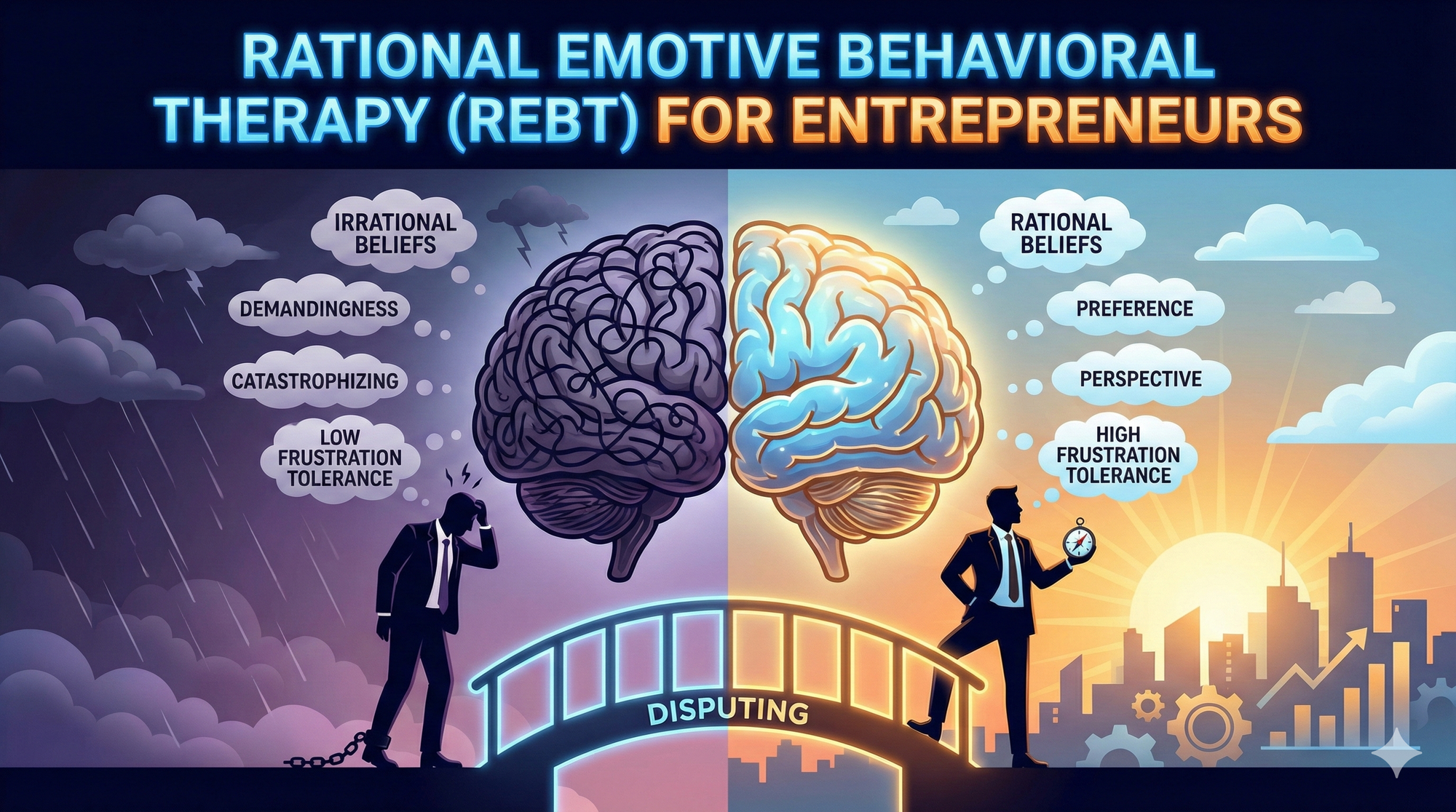
I. Introduction: Your Brain, Your Business, Your Battleground
Entrepreneurship. It’s a wild ride, isn’t it? Full of exhilarating highs and gut-wrenching lows. From the constant financial tightrope walk to the relentless grind of innovation, the pressure is real. And what happens when that pressure mounts? Self-doubt creeps in, anxiety flares, and burnout becomes a very real threat.
This isn't just about external forces; it's about the internal narratives that can make or break you. Enter Rational Emotive Behavioral Therapy (REBT). Developed by the brilliant Dr. Albert Ellis, REBT isn't some fluffy self-help fad; it's a pioneering, no-nonsense form of cognitive behavioral therapy that gives entrepreneurs a powerful framework to navigate these turbulent waters. It’s about identifying and challenging the irrational beliefs that are quietly sabotaging your mental game, transforming setbacks into springboards, and forging the mental resilience you need to thrive.
Why Your Thoughts Are Your Toughest Competitor: A Direct Answer
Your thoughts are your toughest competitor because, in entrepreneurship, it's rarely the external event itself that crushes you; it's your interpretation of it. REBT for entrepreneurs teaches that irrational beliefs about challenges—like a failed product launch or a tough negotiation—fuel negative emotions and self-defeating actions. By actively disputing these internal narratives, you gain control over your emotional responses, allowing you to pivot from despair to problem-solving, from paralysis to persistent action. This mental mastery is the ultimate competitive advantage.
II. Understanding REBT: The ABCs of Entrepreneurial Resilience
At its core, REBT for entrepreneurs is about one undeniable truth: your mind is a powerful machine, and you get to program it. It’s not the market downturn that causes your panic; it’s your belief about what that downturn means for you. This fundamental concept is distilled into the elegant simplicity of the ABC model:
- A (Activating Event): This is the objective reality. A product launch flops. A key investor says no. A competitor outmaneuvers you. It’s just what happened.
- B (Beliefs): This is where the magic (or mischief) happens. It’s your internal narrative about that activating event. Do you tell yourself, "I'm a complete failure, and my business is doomed" (an irrational belief)? Or do you pivot to, "This launch didn't go as planned, but I'm going to dissect it, learn from it, and come back stronger" (a rational belief)?
- C (Consequences): These are the emotional and behavioral fallout. Irrational beliefs lead to anxiety, procrastination, giving up. Rational beliefs? They spark constructive emotions and actions: problem-solving, persistence, and a relentless drive forward.
Dr. Albert Ellis, the OG behind REBT, knew that humans are wired for both brilliance and self-sabotage. For us entrepreneurs, recognizing and actively disputing those self-defeating, irrational beliefs isn't just a nice-to-have; it's crucial for sustained success and sanity. These beliefs often show up as rigid demands (e.g., "I must succeed at everything, or I'm worthless"), awfulizing (e.g., "This setback is catastrophic—the end of the world!"), low frustration tolerance (e.g., "I can't stand this difficulty; it's too hard!"), and global evaluations of self or others (e.g., "Because I failed, I am a failure"). Sound familiar? Time to change the script.
III. Dismantling Irrational Beliefs: Your Inner Arena Workout
To truly dominate the entrepreneurial game, you need to master rational emotive behavioral therapy techniques. These aren't just academic exercises; they're your inner arena workout, empowering you to challenge and replace those self-limiting thought patterns with ones that actually serve your ambition.One of the primary techniques is cognitive restructuring. This is your systematic process for identifying, challenging, and then rewriting those irrational beliefs. For an entrepreneur, this looks like:
- Identifying the Belief: When that business setback hits, what's the immediate, gut-level thought? "I'm not good enough to run this business." Bingo. That's your irrational belief.
- Challenging the Belief: Now, put it on trial. Is there any objective evidence that one setback defines your entire capability? What other factors were at play? What would a truly rational, objective observer conclude? This isn't about denial; it's about ruthless honesty.
- Replacing the Belief: Finally, swap out that toxic narrative for a powerful, helpful one. "This setback is a brutal but valuable learning experience. I have the intelligence and drive to analyze what went wrong, adapt my strategy, and come back stronger. My worth as an entrepreneur isn't tied to a single outcome." This is how you program for success.
REBT also brings in three core acceptances that are pure gold in the entrepreneurial jungle:
- Unconditional Self-Acceptance (USA): You're human. You'll screw up. Accept yourself as a fallible being who makes mistakes, without letting those mistakes define your entire worth. For entrepreneurs, this means acknowledging that failures are part of the journey without letting them shatter your self-concept. This is a crucial step in Unlocking Your Potential: Overcoming Limiting Beliefs About Self-Worth.
- Unconditional Other-Acceptance (UOA): Your team, your partners, your clients—they're human too. They'll frustrate you. Accept them as fallible beings, even when their actions drive you nuts. This is key for managing relationships, fostering empathy, and reducing the kind of interpersonal conflict that drains entrepreneurial energy.
- Unconditional Life-Acceptance (ULA): Life isn't fair. The market is unpredictable. Challenges are inevitable. Accept that discomfort and obstacles are part of the game. ULA helps you tolerate these harsh realities without getting overwhelmed, keeping you in the fight.
Beyond the head-on cognitive assault, REBT also throws in behavioral techniques. Ever fear public speaking or pitching to investors? Exposure therapy can help. Gradually expose yourself to those feared situations until the anxiety shrinks. Or, if you're terrified of social disapproval, shame-attacking exercises (within ethical bounds, of course) can help you realize that the perceived negative consequences are often wildly exaggerated. This is about building real-world courage, not just mental gymnastics.
IV. Cognitive Behavioral Coaching: Your Entrepreneurial Edge
Integrating REBT principles into your game isn't just smart; it's your entrepreneurial edge. You can become your own coach, applying the ABC model and disputing techniques to your daily challenges. This self-coaching approach cultivates a proactive mindset, allowing you to identify and defuse emotional roadblocks before they become full-blown crises. It's about being proactive, not reactive, in your mental game.And if you're a leader, understanding REBT can revolutionize your team dynamics. By promoting rational thinking, you can help your team manage stress, sharpen their problem-solving skills, and build a more resilient work environment. Imagine guiding your team through a project failure by focusing on learning and adaptation rather than blame. That's how you prevent a spiral of demotivation and foster a culture of growth.
V. Conclusion: Your Mind, Unleashed
Rational Emotive Behavioral Therapy isn't just therapy; it's a strategic weapon for the entrepreneur. It provides an invaluable toolkit for forging mental resilience and achieving sustained success. By understanding and actively challenging those sneaky irrational beliefs through techniques like cognitive restructuring, and by embracing unconditional acceptance (of self, others, and life's inevitable curveballs), you can fundamentally transform your responses to adversity. Integrating REBT into your self-coaching practice or leadership style empowers you to navigate challenges with laser-like clarity, rock-solid emotional stability, and an unwavering commitment to growth. The entrepreneurial journey is demanding, no doubt, but with REBT, it becomes a profound path of self-discovery and unstoppable progress. Embrace these principles, and unleash a more rational, resilient, and ultimately rewarding entrepreneurial experience. Your mind is your greatest asset; learn to wield it.
Why I Wrote This
I've seen it too many times: brilliant entrepreneurs, armed with incredible ideas and relentless drive, get derailed by their own minds. The psychological pressures of building a business are immense, and traditional business advice often glosses over the internal battle. I wrote this article because REBT offers a uniquely practical, empowering, and actionable approach to cultivating the mental resilience that isn't just essential for entrepreneurial success, but for sheer survival. It's not about managing stress; it's about fundamentally shifting your perspective to embrace challenges, learn from every setback, and maintain an unshakeable sense of self-worth, regardless of the P&L. My hope is that by demystifying REBT and showing its direct applicability to the business world, more entrepreneurs will discover this powerful tool for navigating their demanding, yet incredibly rewarding, path.
Recommended Resources
Ready to dive deeper into the nuts and bolts of Rational Emotive Behavioral Therapy and its applications? These resources are your next steps:
Books:
- A Guide to Rational Living by Albert Ellis and Robert A. Harper: A foundational text explaining REBT principles: A Guide to Rational Living.
- How to Stubbornly Refuse to Make Yourself Miserable About Anything—Yes, Anything! by Albert Ellis: A practical guide to applying REBT in daily life: How to Stubbornly Refuse to Make Yourself Miserable About Anything—Yes, Anything!.
Websites:
- Albert Ellis Institute: The official website for resources, training, and information on REBT.
- REBT Network: Another valuable resource for articles and information on REBT.