Limiting Beliefs and the Law of Attraction: Fact vs. Fiction
Manifestation in leadership debunked? Discover the psychological truth behind the Law of Attraction and how to use intentional thinking to drive real results.

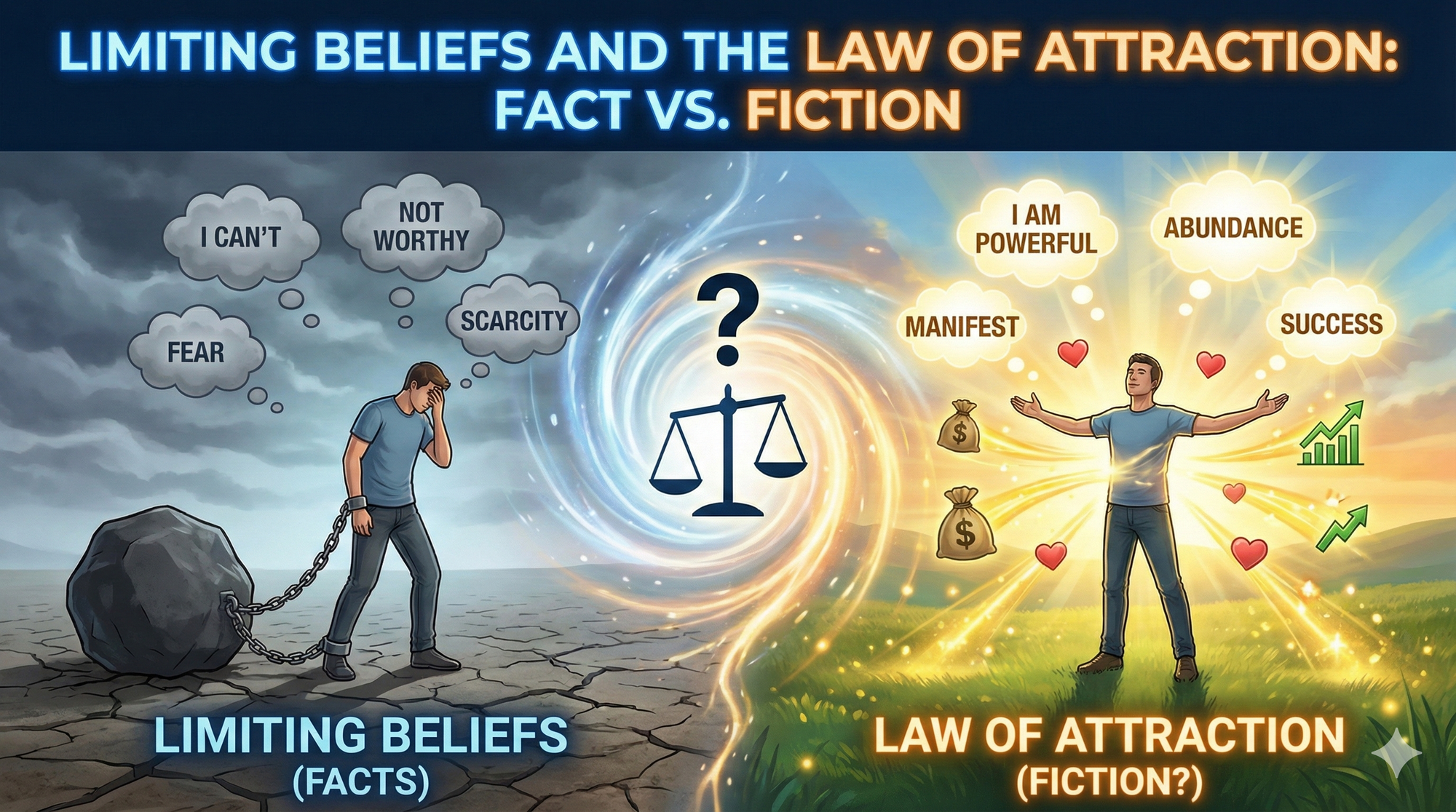
I. Introduction: The Allure of Effortless Manifestation
The Law of Attraction—that seductive whisper promising that your thoughts alone can bend reality to your will—has been a cornerstone of "old school self-help" for decades. Its appeal is undeniable, especially when it promises effortless success in areas like business and wealth creation. But let's be honest: if simply thinking about a million dollars made it appear, we'd all be swimming in cash.
While the Law of Attraction offers a comforting narrative, a critical examination reveals a far more complex interplay between mindset and outcomes. This article isn't here to debunk; it's here to dissect. We'll strip away the fiction, contrasting the often-simplistic narratives of manifestation with the factual, evidence-based principles of psychology that truly drive success in modern leadership.
We'll explore how concepts like manifestation in leadership are being redefined by scientific understanding, moving beyond mere positive thinking to embrace strategic action and a deep understanding of your own Inner Arena. Ultimately, we aim to clarify the role of these self-help tenets in contemporary business, contrasting them with the robust insights offered by positive psychology vs self-help's more traditional, less empirical approaches.
Can You Really "Think" Your Way to Success? A Direct Answer
While positive thinking and a clear vision are powerful catalysts, the idea that you can "think" your way to success through the Law of Attraction alone is largely fiction. True manifestation in leadership and business is not a mystical process; it's a strategic blend of a positive mindset, proactive planning, consistent execution, and a deep understanding of psychological principles.
Limiting beliefs, not negative vibrations, are the real obstacles. Success is attracted not by passive wishing, but by aligning your internal narratives with tangible actions, dismantling self-sabotaging beliefs, and cultivating a resilient, action-oriented mindset grounded in evidence-based psychology.
II. The Evolution of Self-Help: From Wishful Thinking to Strategic Action
The self-help landscape has undergone a seismic shift. What once comprised anecdotal advice and often unsubstantiated claims—the very bedrock of the Law of Attraction—has matured into a field increasingly informed by psychology, neuroscience, and organizational behavior. Early self-help, while inspiring, often lacked empirical backing, leading to skepticism and a perception of being overly simplistic. The emphasis was heavily on positive thinking, visualization, and affirmations as primary drivers, often overlooking the brutal reality of strategic action, skill development, and the sheer grit required to face adversity.
But here's the kicker: modern approaches, while still valuing a positive mindset, integrate principles from positive psychology and cognitive behavioral therapy (CBT). These aren't feel-good platitudes; they're evidence-based methodologies focused on identifying and challenging cognitive distortions, building self-efficacy through achievable goals, and fostering a growth mindset.
Research in positive psychology, for instance, highlights the importance of gratitude, mindfulness, and character strengths in enhancing well-being and performance, providing a scientific framework that moves beyond the more mystical interpretations of manifestation. This shift acknowledges that while belief systems are powerful, they are most effective when coupled with concrete actions and a realistic understanding of external factors. The contemporary view recognizes that success in business, particularly for leaders, is a complex interplay of internal drive, strategic execution, and adaptive learning, rather than solely the result of attracting desired outcomes through thought alone.
III. Limiting Beliefs: The Real Obstacle to Your "Attraction"
Here's where the rubber meets the road. While the Law of Attraction often fixates on the power of positive thought, a more grounded perspective in psychology points to the profound impact of limiting beliefs. These are the deeply ingrained assumptions you hold about yourself, others, or the world, which actively restrict your potential and hinder your progress. Unlike external obstacles, limiting beliefs operate internally, shaping your perceptions, influencing your decisions, and ultimately dictating your actions. For a business leader, a limiting belief might manifest as "I'm not good enough to lead a large team," or "Innovation is too risky for our established company." Such beliefs, whether conscious or subconscious, don't just exist; they create self-fulfilling prophecies. Not because the universe is responding to a 'negative vibration,' but because these beliefs lead to inaction, missed opportunities, or self-sabotaging behaviors.The connection between limiting beliefs and the outcomes you experience isn't mystical; it's psychological. Cognitive science demonstrates that your beliefs influence your attention, memory, and interpretation of events. If you, as a leader, believe you are incapable of success, you are more likely to notice failures, dismiss successes, and avoid challenges that could prove your belief wrong. This cognitive bias reinforces the limiting belief, creating a cycle that can be brutal to break. Effective leadership development and personal growth, therefore, must involve identifying and challenging these deeply held convictions. Techniques derived from cognitive restructuring, a core component of CBT, help you critically examine the evidence for your beliefs, consider alternative perspectives, and gradually replace unhelpful thoughts with more empowering ones. This process isn't about merely 'thinking positively' but about actively reshaping your internal narrative to align with desired outcomes and strategic goals, thereby enabling more effective action and resilience.
IV. Modern Leadership and Manifestation: Beyond Passive Wishing
In the context of modern leadership, the concept of "manifestation" takes on a far more pragmatic and actionable meaning. It moves light-years beyond the passive visualization often associated with the Law of Attraction. For today's business leaders, manifestation is less about wishing for success and more about strategically creating the conditions for it. This involves a blend of clear vision, proactive planning, consistent execution, and an unwavering commitment to overcoming challenges. While a positive mindset is undoubtedly beneficial, it serves as a foundation for resilience and motivation, rather than a magical conduit for desired outcomes.Effective leaders understand that manifestation in leadership is a dynamic process that integrates several key elements:
- Visionary Goal Setting: Clearly defining what success looks like, not just in terms of outcomes, but also the processes and values that underpin it. This clarity provides a roadmap and energizes teams.
- Strategic Planning and Execution: Translating the vision into concrete, actionable steps. This involves rigorous analysis, resource allocation, risk management, and diligent follow-through. The "attraction" here is a direct result of well-executed strategy.
- Cultivating a Growth Mindset: Embracing challenges as opportunities for learning and development, rather than as insurmountable obstacles. This psychological flexibility allows leaders and their teams to adapt and innovate.
- Building Strong Relationships and Networks: Recognizing that success is rarely achieved in isolation. Collaboration, mentorship, and a supportive professional network are crucial for opening doors and fostering opportunities.
- Emotional Intelligence and Self-Awareness: Understanding one's own emotions and their impact, as well as empathizing with others. This enables more effective communication, conflict resolution, and team cohesion. Daniel Goleman's work on Emotional Intelligence is foundational here.
This contemporary view of manifestation aligns closely with principles of positive psychology, which emphasizes the cultivation of strengths, engagement, positive relationships, meaning, and accomplishment (PERMA model). It suggests that while the "old school self-help" principles might have highlighted the importance of belief, modern leadership translates that belief into tangible actions and measurable progress. The "Law of Attraction" in a business context is thus reinterpreted as the natural consequence of focused effort, strategic thinking, and a resilient, action-oriented mindset, rather than a mystical force.
V. Conclusion: The Inner Architect of Your Reality
The Law of Attraction, stripped of its mystical trappings, reveals a profound truth: your beliefs do shape your reality. But not through cosmic ordering; through the actions, decisions, and resilience they inspire (or inhibit). As a leader, your power to manifest isn't about passive wishing; it's about becoming the inner architect of your reality.
It's about consciously dismantling the limiting beliefs that hold you back, strategically planning your ascent, and executing with an unwavering commitment. This is the true "magic" of manifestation: the relentless, intentional work of aligning your Inner Arena with your external ambitions. Stop waiting for the universe to deliver; start building the universe you desire.
Why I Wrote This
I've seen too many brilliant minds get caught in the trap of passive manifestation, waiting for the universe to deliver rather than actively building their empires. My experiences, particularly in the trenches of entrepreneurship, have shown me that while mindset is everything, it's the action driven by that mindset that truly transforms. This article is my call to arms for leaders to embrace a more pragmatic, psychologically grounded approach to manifestation—one that empowers them to be the architects of their own success, not just hopeful observers. It's about demystifying the woo-woo and grounding it in the brutal, beautiful reality of strategic self-upgrading.
Recommended Resources
For those ready to dive deeper into the science of mindset, action, and genuine manifestation:
- Positive Psychology: For a deeper dive into the scientific study of human flourishing, explore resources from the Positive Psychology Center at the University of Pennsylvania.
- Cognitive Behavioral Therapy (CBT): Learn more about identifying and challenging limiting beliefs through the principles of CBT. A good starting point is the Beck Institute for Cognitive Behavior Therapy.
- Growth Mindset: Carol Dweck’s seminal work on growth mindset is essential reading for leaders. Explore her research and insights on Mindset Online.
- Emotional Intelligence: Daniel Goleman’s work on emotional intelligence provides valuable insights for leadership development. Resources can be found on his official website.