Imposter Syndrome vs. Limiting Beliefs: Understanding the Nuances
Ever feel like a fraud despite your success? Understand the nuances between Imposter Syndrome and limiting beliefs, and discover targeted strategies to conquer both.

I. Introduction: The Inner Voice of Doubt
Ever feel like you're faking it? Like any moment, someone's going to pull back the curtain and expose you as a fraud? Or perhaps you're constantly battling an internal narrative that whispers, "You're not good enough," or "You don't deserve this." These aren't just fleeting thoughts; they're two distinct, yet often intertwined, psychological phenomena that can derail even the most talented entrepreneurs and leaders: Imposter Syndrome and Limiting Beliefs. While both manifest as self-doubt and hinder potential, understanding their nuances is crucial for effective self-upgrading. This article will dissect the differences, highlight the overlaps, and equip you with the clarity to tackle each head-on.
Imposter Syndrome vs. Limiting Beliefs: A Direct Answer
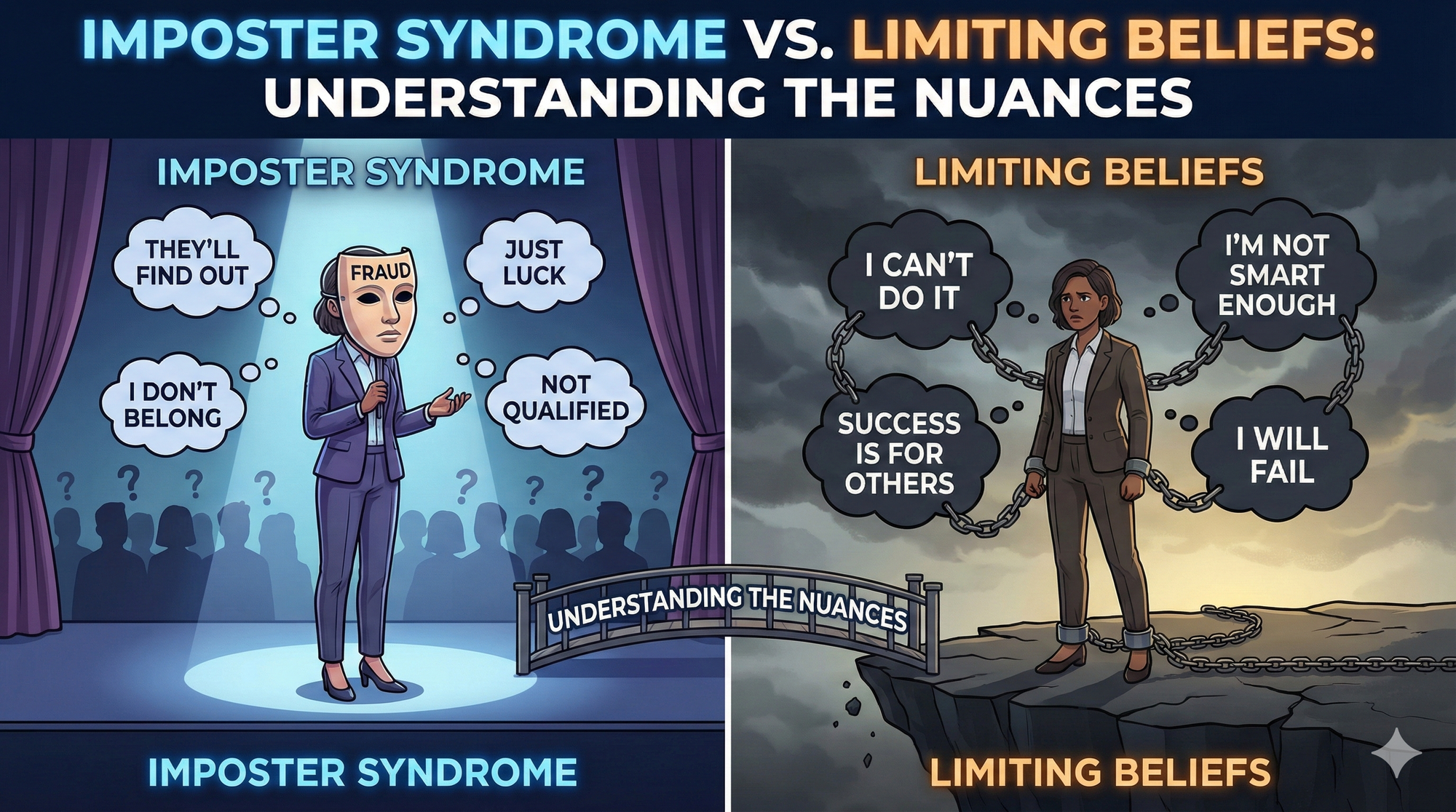
Imposter Syndrome is a specific pattern of self-doubt where individuals, despite objective evidence of their competence, fear being exposed as a fraud and attribute their successes to luck or external factors. It's the fear of being "found out." Limiting beliefs, on the other hand, are broader, deeply ingrained convictions about oneself, others, or the world that restrict one's potential (e.g., "I'm not smart enough," "Money is evil"). While Imposter Syndrome can be a manifestation of certain limiting beliefs (like "I'm not good enough"), limiting beliefs encompass a wider range of self-imposed restrictions that may or may not involve feelings of fraudulence. The key distinction? Imposter Syndrome is about feeling like a fraud despite success; limiting beliefs are about preventing success in the first place.
II. The Overlap and the Distinction: Why It Matters
It's easy to conflate these two. Both Imposter Syndrome and Limiting Beliefs create an internal landscape of doubt and can paralyze action. Both feed into that Narrative -> Emotion -> Action framework we discussed in Entering the Inner Arena: Your Framework for Self-Upgrading. But understanding where they diverge is key to applying the right solution. This isn't just semantics; it's about precision in your inner work.
Imposter Syndrome: The Fear of Exposure
Imposter Syndrome is that nagging feeling that you're not as competent as others perceive you to be. You might have achieved significant success—a promotion, a successful startup, a prestigious award—yet you attribute it to luck, timing, or deceiving others into thinking you're smarter than you are. The core fear isn't just failure; it's exposure. It's the dread of being found out, of having your mask slip. This often affects high-achievers, who set impossibly high standards for themselves and discount their own abilities. As Valerie Young, a leading expert on the topic, explores in her book The Secret Thoughts of Successful Women, this phenomenon is far more common than you think.
Limiting Beliefs: The Self-Imposed Ceiling
Limiting beliefs are more fundamental. They are the core assumptions you hold about reality that restrict your potential. They're the "I can't do X because Y" statements that run your life. For example, a belief like "I'm not creative" might stop you from pursuing an innovative idea, regardless of your actual talent. Or "I don't deserve success" might lead to self-sabotage just as you're about to achieve a breakthrough. These beliefs are often broader and can exist even without the specific fear of being a "fraud." They are the invisible walls we discussed in The Ultimate Guide to Identifying and Overcoming Limiting Beliefs.
III. How They Intersect: When Limiting Beliefs Fuel Imposter Syndrome
While distinct, limiting beliefs can certainly fuel Imposter Syndrome. If you hold a core limiting belief like "I'm not good enough" or "I'm not smart enough," then any success you achieve will naturally feel undeserved. This creates the perfect breeding ground for Imposter Syndrome, as your internal narrative constantly clashes with external validation. The success feels like a fluke because it contradicts your deeply held belief about your own inadequacy. It's a vicious cycle where your internal narrative undermines your external reality.
IV. Actionable Strategies: Tailoring Your Approach
To effectively tackle these internal hurdles, you need a targeted approach. This isn't a one-size-fits-all solution; it requires precision in your Inner Arena work.
For Imposter Syndrome: Unmasking the Fraud
- Acknowledge and Normalize: You're not alone. Imposter Syndrome is incredibly common, especially among high-achievers. Simply naming it can reduce its power. Talk about it.
- Track Your Achievements: Keep a detailed, objective record of your successes, skills, and positive feedback. When the doubt creeps in, refer to this objective evidence. This directly counters the tendency to discount your accomplishments.
- Separate Feelings from Facts: The feeling of being a fraud is not the fact of being a fraud. Your emotions are valid, but they don't always reflect reality. Challenge the narrative, as taught in Rational Emotive Behavioral Therapy (REBT) for Entrepreneurs.
- Share Your Feelings: Talk to trusted mentors, colleagues, or friends. You'll often find they've experienced similar feelings, which can be incredibly validating and reduce the sense of isolation.
- Focus on Contribution, Not Perfection: Shift your focus from being perfect to making a valuable contribution. Your worth isn't tied to flawless execution, but to your effort and impact. This aligns with a growth mindset as explored by Carol Dweck.
For Limiting Beliefs: Rewriting Your Operating System
- Identify the Core Belief: Go beyond the surface. What is the fundamental assumption driving your behavior? Use journaling or self-reflection to pinpoint the exact narrative. This is the first step in The Ultimate Guide to Identifying and Overcoming Limiting Beliefs.
- Challenge the Narrative: Question the validity of this belief. Where did it come from? Is it truly serving you? Seek out counter-evidence in your own life or in the lives of others. David D. Burns' classic Feeling Good: The New Mood Therapy offers powerful techniques for this.
- Reframe and Replace: Actively construct a new, empowering narrative. If the belief is "I'm not creative," replace it with "I am capable of innovative thinking and problem-solving." This is the essence of the Narrative -> Emotion -> Action framework.
- Take Aligned Action: Engage in small, consistent actions that directly contradict the old belief and reinforce the new one. If you believe you're not creative, start a small creative project. Each step builds momentum. This is about embracing imperfection.
- Seek External Perspective: A coach or mentor can be invaluable in helping you identify and challenge limiting beliefs that are deeply ingrained and hard to see on your own. Jonathan Heston's The Unlimited Self provides further guidance here.
V. Conclusion: Mastering Your Inner Landscape
Both Imposter Syndrome and Limiting Beliefs are powerful internal forces that can hinder your potential. But they are not insurmountable. By understanding their distinct characteristics and applying targeted strategies, you can begin to master your inner landscape. This isn't about eradicating doubt entirely; it's about developing the awareness and tools to navigate it, allowing you to step into your full power and make the impact you're truly capable of. The work in your Inner Arena is continuous, but the freedom it brings is immeasurable. It's time to stop letting these internal narratives dictate your reality and start writing your own story of success.
Why I Wrote This
In my journey through entrepreneurship, I've encountered countless brilliant individuals who, despite their external achievements, wrestled with profound internal doubts. Distinguishing between Imposter Syndrome and broader limiting beliefs became crucial for effective coaching and self-development. This article is my attempt to provide that clarity, offering a roadmap for anyone ready to confront these inner adversaries and unlock their true potential. Because clarity is power, and your potential is limitless.
Recommended Resources
For those ready to dive deeper and continue their journey of self-upgrading, these resources offer profound insights and practical tools:
- The Secret Thoughts of Successful Women: Why Capable People Suffer from the Impostor Syndrome and How to Thrive in Spite of It by Valerie Young
- Mindset: The New Psychology of Success by Carol S. Dweck
- The Unlimited Self: Destroy Limiting Beliefs, Uncover Inner Greatness, and Live the Good Life by Jonathan Heston
- Feeling Good: The New Mood Therapy by David D. Burns