Hyperobjects
We are like blind men touching an elephant. Hyperobjects are systems too vast to perceive, yet they dictate our world. Learn the framework to manage complexity.


A common theme in my journey has been my confrontation with hyperobjects. These concepts exist in multiple different facets making them some of the trickiest things to deal with.
The term was brought into popularity by Timothy Morton through his book, "Hyperobjects: Philosophy and Ecology after the End of the World", but I'd loosen my interpretation as they are by definition, difficult to define. Examples of hyperobjects are climate change, relativity, and consciousness.
In this piece I lean more towards what I notice about hyperobjects as opposed to pursuing a proper definition.
Why Hyperobjects are Difficult to Perceive
Complexity: Hyperobjects exhibit complexity, they can be systems, multi-faceted or ambiguous in many regards.
Ambiguity: how is it even possible to attack something you can't even define, further as it exists in one dimensional framework, how does a person manage to perceive the whole enough to even tackle the problem
The Blind Men and the Elephant
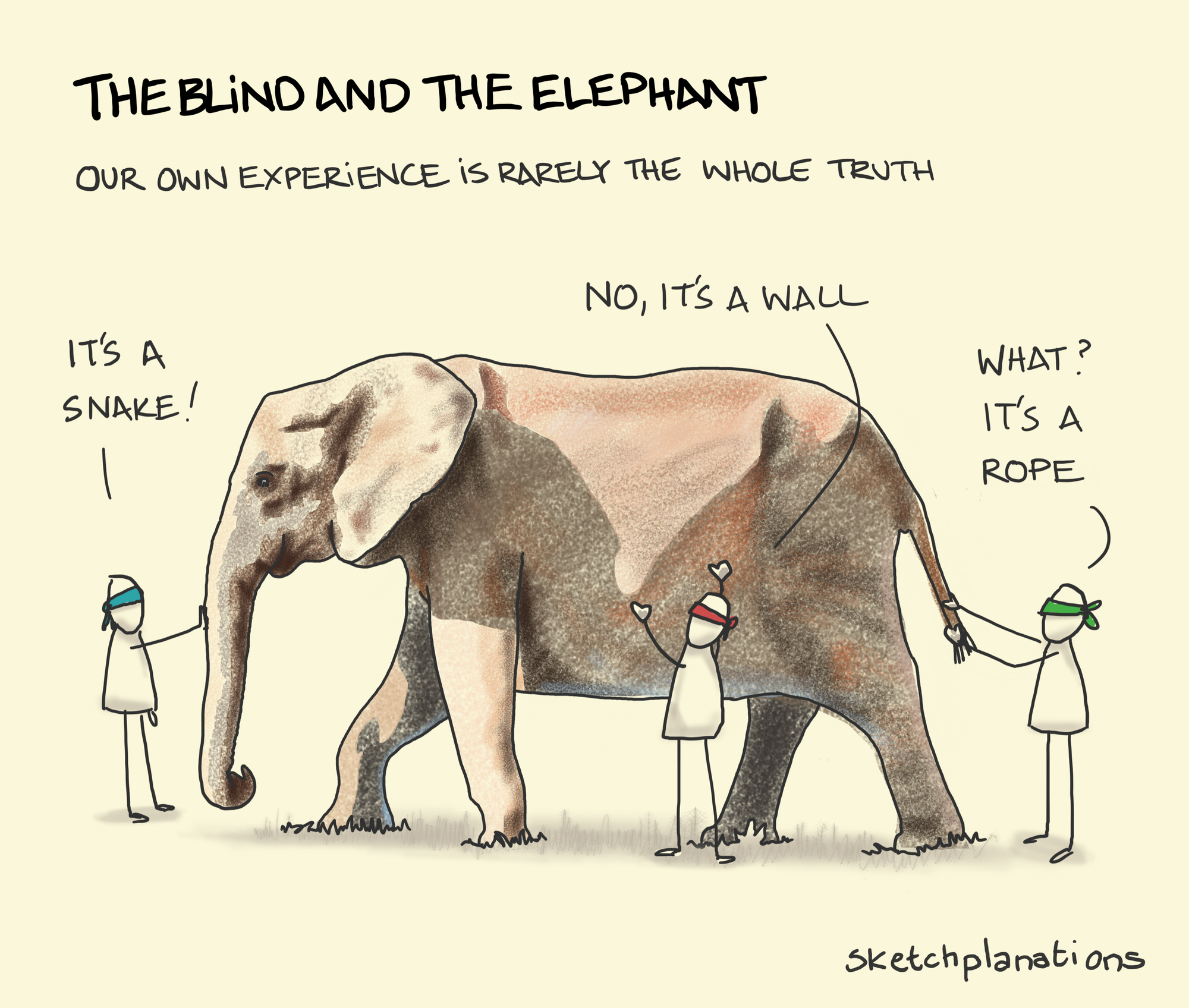
To understand why hyperobjects are so difficult to manage, we have to look at the ancient parable of the blind men and the elephant.
In the story, several men encounter an elephant for the first time. Each touches a different part:
- The one holding the trunk insists the creature is a thick snake.
- The one leaning against the side is certain it is a massive wall.
- The one feeling the tusk argues it is a sharp spear.
- The one grasping the leg claims it is a sturdy tree.
They are all technically "correct" based on their local data, yet they are all completely wrong about the nature of the elephant.
This is our relationship with hyperobjects. When we look at a hyperobject like "Global Economics" or "The Internet," we are the blind men. One person sees a stock market crash (the tusk), another sees a viral video (the tail), and a third sees a supply chain disruption (the trunk). Because we can only perceive a "slice" of the object at any given time, we end up arguing over the symptoms rather than addressing the entity itself.
The "ambiguity" I mention isn't just a lack of information; it is a fundamental limit of perspective. We are trying to define a three-dimensional "elephant" from a two-dimensional point of view. Until we acknowledge that our individual "instantiations" are just fragments of a larger gestalt, we will continue to fight over snakes and spears while the elephant remains unaddressed.
How to Manage Hyperobjects
Resiliency: Hyperobjects are misperceived and thus, a human being's inability to perceive correctly or worse, establish consensus perception of a hyperobject makes it resilient to any correction even from groups. Further, any attack vector in only instantiation of its existence makes it further resilient.
I'd also make the case that hyperobjects can disguise themselves as mere words. Take for example "climate change". This is just how weather is more extreme because of pollution. However, this heavily reduces the existence of the phenomena which spans the integration and existence of highly complex systems, scientific fields, and human behavior.
Tools to Deal with Hyperobjects
Essential and holistic understanding: One can not understand the entirety of something, but one can hope to understand the essential both in minutiae but also holistic gestalts.
Pinning down immutable principles: Hyperobjects can slip out of understanding because they do not obey intuitive understanding. Thus, immutable principles must be established and collected based on depth and breadth of understanding.
Sophistication in approach: Complex problems require complex solutions either in systems or deliberation in intention.
Summary
I offer this post as a fundamental building block introducing the idea of hyperobjects as I attempt to write about them in other posts.